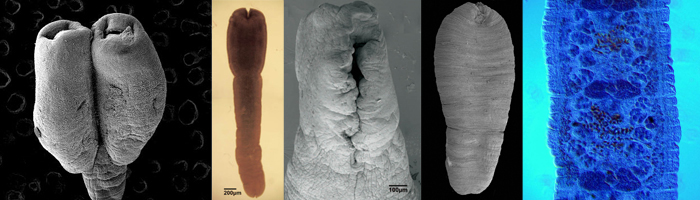
Various diphyllobothriideans (images courtesy of R. Kuchta).
Segmentation complete or incomplete; rarely absent (Ligula). Scolex always unarmed, with pair of attachment grooves (bothria). Apical disc absent, rarely present (Tetragonoporus). Reproductive organs single per segment, rarely double or multiple proglottids in segment (Tetragonoporus); multiple testes; external seminal vesicle thick-walled, attached to proximal part of cirrus-sac; internal seminal vesicle occasionally present; cirrus unarmed. Ovary medullary, compact; genital pore ventral (median or submedian); vitellarium follicular, numerous, cortical, rarely paramuscular (between bundles of inner longitudinal muscles) (Tetragonoporus); uterus tubular, variable in shape, opening to exterior through uterine pore situated posterior to genital pore; uterine sac absent. Eggs usually operculate, unembryonated; ciliated coracidium usually present.
About 240 nominal species (80 valid) in 16 genera.
Order Pseudophyllidea, a well-recognised order of tapeworms, has been recently suppressed because it is composed of two phylogenetically unrelated groups, Bothriocephalidea and Diphyllobothriidea. Sequences of few diphyllobothriidean genera are available but indicate monophyly of extant families. Their comparison indicates that the Cephalochlamydidae and Solenophoridae are basal (parasites of frogs and reptiles) and Diphyllobothriidae (parasites of birds and mammals) is derived. Some genera may be polyphyletic. Haplobothriidea and Caryophyllidea seem to be most closely related to the Diphyllobothriidea.
Mammals (mostly seals and cetaceans) are definitive hosts of the majority of diphyllobothriids (74% of all species), 16% are in birds, 6% in reptiles and 4% are in amphibians. Species of Diphyllobothrium, Diplogonoporus and Spirometra may infect man as adults and larvae (sparganum).
Normally in intestine, occasionally in biliary duct (Tetragonoporus).
Cosmopolitan. About one half of species are known from terrestrial vertebrates, whereas another half parasitize marine vertebrates; only 4% of valid species are in fresh waters. Terrestrial diphyllobothriideans are most common in Eurasia (32% of species) and North America (18%). Nine species have been described from reptiles and amphibians in Africa, whereas Australia and South America are poor in diphyllobothriidean cestodes. Marine diphyllobothriideans are distributed in the northern hemisphere, including Arctic areas; in total, the Arctic Ocean, North Atlantic and North Pacific Oceans account 25% of all taxa. Some genera are exclusively in the Arctic, such as Baylisia, Baylisiella, Flexobothrium, Glandicephalus and Tetragonoporus. The number of diphyllobothriideans reported from tropical and subtropical waters is very low, but 16% of all species were reported from the Antarctic seas.
Two or three hosts in life-cycle. Eggs usually develop in water (not in uterus), a coracidium (hexacanth enclosed in a ciliated envelope) hatches in water and is eaten by a crustacean, generally copepod. Hexacanth penetrates into haemocoel where it develops into procercoid. Plerocercoids develop in second intermediate host – vertebrates (teleosts, amphibians, reptiles, mammals, occasionally man – Spirometra).
Selected References:
Delyamure, S. L., A. S. Skryabin, and A. M. Serdyukov. 1985. Diphyllobothriids – cestodes of man, mammals and birds. Principles of cestodology. K. M. Ryzhikov (ed.). Volume XI. Nauka, Moscow, Russia, 198 p. [In Russian.]
Bray, R. A., A. Jones, and K. I. Andersen. 1994. Order Pseudophyllidea Carus, 1863. In Keys to the cestode parasites of vertebrates, L. F. Khalil, A. Jones, and R. A. Bray (eds.). CAB International, Wallingford, U.K., p. 205–247. PDF
Kamo, H. 1999. Guide to identification of diphyllobothriid cestodes. Genndai Kikaku (for Mrs Atsuyo Kamo), Tokyo, 146 pp. [In Japanese.]
Kuchta, R., T. Scholz, J. Brabec, and R. A. Bray. 2008. Suppression of the tapeworm order Pseudophyllidea (Platyhelminthes: Eucestoda) and the proposal of two new orders, Bothriocephalidea and Diphyllobothriidea. International Journal for Parasitology 38: 49–55. PDF
Taxon Coordinator:
Dr. Roman Kuchta
Institute of Parasitology
Academy of Sciences of the Czech Republic
Branisovská 31
370 05 Ceské Budejovice
Czech Republic
PHONE: ++420-38- 53-10-351
E-MAIL: krtek@paru.cas.cz

