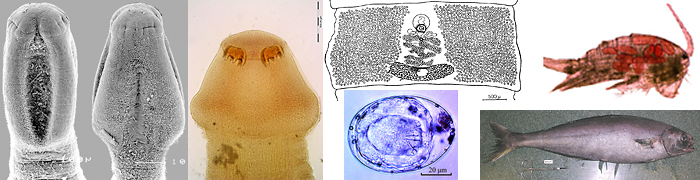
Scolex with pair of attachment grooves (bothria), occasionally absent or replaced by pseudoscolex or scolex deformatus, occasionally with few (Triaenophorus) or many hooks (Polyonchobothrium). Apical disc present or absent. Proglottids mostly craspedote, wider than long, external segmentation occasionally absent (Probothriocephalus). Reproductive organs single in segment, rarely two symmetrical sets of proglottids present in segment; testes multiple; cirrus-sac with or without internal seminal vesicle; cirrus mostly unarmed, occasionally armed with spines (Echinophallus) or with protuberances (Anonchocephalus). Ovary medullary, compact; genital pores on dorsal surface (median or submedian) or lateral, irregularly alternating; vitellarium follicular, rarely compact (Philobythos), cortical, occasionally medullar (Abothrium); uterus variable, divided into tubular, convoluted uterine duct that may enlarge and compact or diverticulate (branched) uterine sac (Bathybothrium); ventral uterine pore present or absent. Eggs with (Bothriocephalus) or without operculum (Eubothrium), may be embryonated in uterus (Abothrium); free ciliated coracidium may be present (Bothriocephalus), eggs are usually not embryonated in the uterus.
More than 300 nominal species (120 valid) in 46 genera.
Order Pseudophyllidea, a well-recognised order of tapeworms, has been recently suppressed because it is composed of two phylogenetically unrelated groups, Bothriocephalidea and Diphyllobothriidea. Bothriocephalidea are divided into four families, but they apparently do not represent natural groupings of phylogenetically related taxa, especially members of the largest and most diverse family Triaenophoridae. Bothriocephalidea seem to represent one of the most derived groups of bothriate cestodes, their sister groups being probably Trypanorhyncha, Diphyllidea and "Tetraphyllidea".
Teleosts are definitive hosts of the majority of bothriocephalideans, but only species of Marsipometra and Polyonchobothrium, and Eubothrium acipenserium are known from archaic fish groups, namely paddle-fish, bichirs and sturgeons. Three species of Bothriocephalus (the genus is undoubtedly polyphyletic) are known in amphibians (salamanders). A total of 65% of valid species parasitize marine fishes and 32% are found in freshwater fishes. Most parasitized group are Perciformes (36%). Species of Eubothrium, Triaenophorus, Bothriocephalus and many others are important as potential pathogens of fishes in aquaculture.
Normally in intestine (often in pyloric caeca), occasionally penetrating intestine wall to be attached in the liver (Bothriocephalus penetratus).
Cosmopolitan. A majority of taxa have been found in the Atlantic (36% of valid species) and Pacific Oceans (25%), 14% are known from the Indian Ocean. The number of freshwater species occurring in Eurasia (22%) is higher than that from North America (14%). The species richness of freshwater bothriocephalideans in other continents is very low (only 2-3% of described taxa).
Two or three hosts in life-cycle. Eggs develop (formation of oncosphere) usually in water (Bothriocephalus) and a coracidium (hexacanth enclosed in a ciliated envelope) hatches in water; in other species (Eubothrium), oncosphere formed in uterus and does not liberate from egg shell. Coracidia or eggs containing oncosphere are eaten by crustacean, generally copepod; hexacanth penetrates into haemocoel where it develops into procercoid. If two hosts are included (Triaenophorus), second host are teleosts, in which plerocercoid develops in musculature or body cavity.
Selected References:
Protasova, E. N. 1977. [Cestodes of fish – Bothriocephalata.] Osnovy Tsestodologii: 8: 298 pp. [In Russian.] PDF
Bray, R. A., A. Jones, and K. I. Andersen. 1994. Order Pseudophyllidea Carus, 1863. In: Keys to the cestode parasites of vertebrates, L. F. Khalil, A. Jones, and R. A. Bray (eds.). CAB International, Wallingford, U.K., p. 205-247. PDF
Kuchta, R. and T. Scholz. 2007. Diversity and distribution of fish tapeworms of the "Bothriocephalidea" (Eucestoda). Parassitologia 49: 21-38. PDF
Kuchta, R., T. Scholz, J. Brabec, and R. A. Bray. 2008. Suppression of the tapeworm order Pseudophyllidea (Platyhelminthes: Eucestoda) and the proposal of two new orders, Bothriocephalidea and Diphyllobothriidea. International Journal for Parasitology 38: 49-55. PDF
Kuchta R., T. Scholz, and R. A. Bray. 2008. Revision of the order Bothriocephalidea Kuchta, Scholz, Brabec & Bray, 2008 (Eucestoda) with amended generic diagnoses and keys to families and genera. Systematic Parasitology 71: 81–136. PDF
Taxon Coordinator:
Dr. Roman Kuchta
Institute of Parasitology
Academy of Sciences of the Czech Republic
Branisovská 31
370 05 Ceské Budejovice
Czech Republic
PHONE: ++420-38- 53-10-351
E-MAIL: krtek@paru.cas.cz

