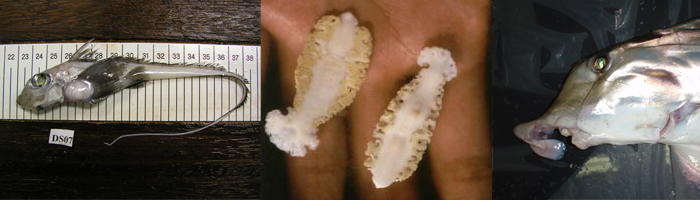
Chimaera monstrosa, Gyrocotyle sp.; head of Callorhinchus capensis (images courtesy of R. Kuchta).
Body monozoic, stout, fusiform to elongate. Anterior extremity with muscular sucker-like attachment organ. Posterior region of body attenuated and normally terminates in rosette-like adhesive organ. Lateral margins fluted or not. Testes follicular, in two anterolateral fields. Cirrus-sac absent. Genital pores separate. Male pore medioventral, between anterior extremity and uterine pore. Ovary follicular, in V- or U-shaped band around seminal receptacle; posterior to uterus. Vaginal pore dorsal, lateral to male pore. Vagina long, reaching back to open into seminal receptacle. Uterus coiled medially in middle of body between seminal receptacle and uterine pore; terminal part of uterus forms uterine sac; uterine pore medioventral, in anterior part of body. Eggs operculate; oncosphere bears ten hooks (decacanth). Vitellarium follicular, filling lateral region of body. Osmoregulatory system reticulate, with two anterior pores.
About 16 nominal species in 1 or 2 genera.
Gyrocotylideans are primitive monozoic cestodes. In many phylogenetic classifications of the parasitic platyhelminths they are considered to be the most basal group of cestodes sensu lato and the most closely related to the Monogenea. Indeed, they have been included in the Monogenea by some workers, but this is not supported by DNA sequences. The relationship between the gyrocotylideans and their holocephalan hosts seems to have existed with little change for more than 350 million years and the origin of the group may be dated even much earlier. Internal phylogeny is unclear.
Gyrocotylideans occur mainly in holocephalan fish, but there are also described from sharks (G. rugosa) and molluscans (as Crobylophorus kroyeri). Known in 10 of 37 species of holocephalan.
Spiral valve, they tend to occur in pairs, are protandric, and are believed to act as a reproductive unit.
Cosmopolitan.
Unknown.
Selected References:
Bandoni S. M. and D. R. Brooks. 1987. Revision and phylogenetic analysis of the Gyrocotylidea Poche, 1926 (Platyhelminthes: Cercomeria: Cercomeromorpha). Canadian Journal of Zoology 65: 2369-2389. PDF
Williams H. H., J. A. Colin, and O. Halvorsen. 1987. Biology of gyrocotylideans with emphasis on reproduction, population ecology and phylogeny. Parasitology 95: 173-207.
Bristow G. A. 1992. On the distribution, ecology and evolution of Gyrocotyle urna, G. confusa and G. nybelini (Cercomeromorpha: Gyrocotylidea) and their host Chimaera monstrosa (Holocephalida: Chimaeridae) in Norwegian waters, with a review of the species question. Sarsia 77: 119-124.
Gibson, D. I. 1994. Order Gyrocotylidea Poche, 1926. In Keys to the cestode parasites of vertebrates, L. F. Khalil, A. Jones, and R. A. Bray (eds.). CAB International, Wallingford, U.K., p. 11-13. PDF
Taxon Coordinator:
Dr. Roman Kuchta
Institute of Parasitology
Academy of Sciences of the Czech Republic
Branisovská 31
370 05 Ceské Budejovice
Czech Republic
PHONE: ++420-38- 53-10-351
E-MAIL: krtek@paru.cas.cz

