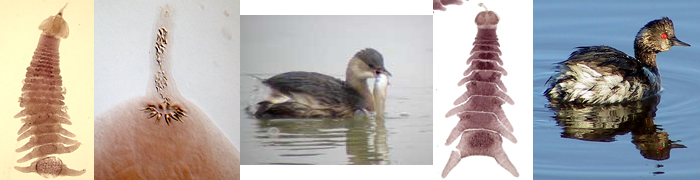
Tatria biremis; rostellum of Joyeuxlepis pilatus; Little grebe (Tachybaptus ruficollis), host of J. pilatus; Tatria gulyaevi; Eared grebe (Podiceps nigricolis), host of T. gulaevi. (Photos of amabiliids courtesy of B. Georgiev; Tachybaptus, http://oiseau.digi.free.fr; Podiceps, http://www.utahbirds.org)
Small to medium sized cestodes. Scolex with 4 oval, muscular suckers. Apex of scolex with rostellum or in the form of hypertrophied petaloid lobes. Rhynchus long, sometimes bearing accessory hooks and spines. Rostellar sac and armed rostellum present, rostellar hooks in a single row. Proglottids wider than long, craspedote, usually with digitiform lateral processes. Strobilar development proterogynous or androgynous. Osmoregulatory canals in 2 to 3 pairs, each pair, or only ventral pair, forming anastomoses. One or 2 sets of male genitalia per proglottid. Male genital ducts passing between osmoregulatory ducts. Testes posterior or lateral to female gonads. Cirrus sac reaching poral osmoregulatory canals or not. External seminal vesicle present, internal seminal vesicle present or absent. Cirrus armed. Vagina absent or present, not reaching the genital atrium. May be functionally replaced by accessory ducts that connect seminal receptacles in successive proglottids with either apertures on lateral, dorsal or ventral surfaces, or with osmoregulatory system. Uterus sac-like. Eggs round or fusiform, with or without filaments.
Eight nominal genera, 26 nominal species. Three subfamilies (Amabiliinae, Schistotaeniinae, and Diporotaeniinae) are recognized, but not generally accepted.
The monophyly of the family is doubtful. Phylogenetic studies suggest that some amabiliids form a monophyletic group with the Progynotaeniidae, Acoleidae and Dioecocestidae. Some authors consider Amabilia (parasites of flamingos) and the remaining genera to represent different families; for the latter genera, the family Schistotaeniidae was erected. Recent molecular studies revealed that the amabiliid genera from grebes are basal to the remaining amabiliid genera which possess a sac-like rostellar apparatus.
Podicipediform (grebes) and phoenicopteriform birds (flamingos).
Small intestine.
Europe, Asia, Africa, North and South America.
Two-host life-cycle. Intermediate hosts are aquatic insects.
Selected References:
Ryzhikov, K. M. and L. M. Tolkacheva. 1981. [Acoleata-tapeworms of birds]. Osnovy Tsestodologii 10: 215 pp. [in Russian.] PDF
Jones, A. 1994. Family Amabiliidae Braun, 1900. pp. 400-405. In Khalil, L. F., Jones, A., Bray, R. A. (Eds.) Keys ot the cestode parasites of vertebrates. CAB International, Wallingford, U.K. PDF
Vasileva, G. P., D. I. Gibson, and R. A. Bray. 2003. Taxonomic revision of Joyeuxilepis Spassky, 1947 (Cestoda: Amabiliidae): redescriptions of J. acanthorhyncha (Wedl, 1855) and J. fuhrmanni (Solomon, 1932), a key and a new generic diagnosis. Systematic Parasitology 56: 219-233. PDF
Vasileva, G. P., D. I. Gibson, and R. A. Bray. 2003. Taxonomic revision of Joyeuxilepis Spassky, 1947 (Cestoda: Amabiliidae): redescriptions of J. biuncinata (Joyeux & Baer, 1943), J. decacantha (Fuhrmann, 1913) and J. pilatus Borgarengo & Gulyaev, 1991. Systematic Parasitology 56: 17-36. PDF
Vasileva, G. P., D. I. Gibson, and R. A. Bray. 2003. Taxonomic revision of Tatria Kowalewski, 1904 (Cestoda: Amabiliidae): redescriptions of T. biremis Kowalewski, 1904, and the description of T. gulyaevi n. sp. from Palaearctic grebes. Systematic Parasitology 54: 177-198. PDF
Vasileva, G. P., D. I. Gibson, and R. A. Bray. Taxonomic revision of Tatria Kowalewski, 1904 (Cestoda: Amabiliidae): redescriptions of T. appendiculata Fuhrmann, 1908 and T. duodecacantha Olsen, 1939, a key and an amended diagnosis of Tatria (sensu stricto). Systematic Parasitology 55: 97-113. PDF
Taxon Coordinator:
Dr. Gergana P. Vasileva
Institute of Biodiversity and Ecosystem Research
Bulgarian Academy of Sciences
2 Gagarin Street
1113 Sofia
Bulgaria
E-MAIL: gpetrunova@gmail.com