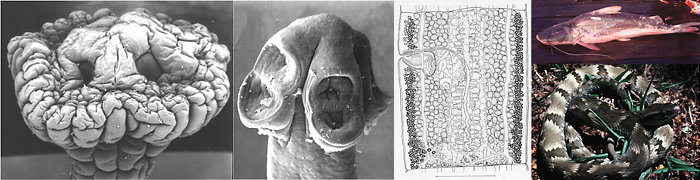
Scanning electron micrograph (SEM) image of scolex of Rudolphiella szidati; SEM of scolex of Chambriella paranensis; mature proglottid of Monticellia ventrei; proteocephalidean hosts: Brachyplatysoma filamentosum (top), Bothrops jararaca (bottom). (Photos courtesy of A. de Chambrier)
Scolex with or without metascolex, may have an apical organ (glandular or glandulo-muscular), a functional or vestigial apical sucker, or a rostellum-like organ armed with hooklets, thus resembling that of cyclophyllidean cestodes. Scolex normally with 4 muscular suckers; suckers uni-, bi-, tri- or quadriloculate. Proglottids usually anapolytic, with multiple testes (20 to more than 500). Ovary bilobed and posterior. Vitelline follicles usually arranged in 2 lateral bands. Vagina opens anterior and/or posterior to cirrus-sac. Genital pores lateral and irregularly alternating. Uterus usually exhibiting lateral diverticula. Eggs spherical, with hyaline outer envelope.
Almost 400 species in 64 genera and 12 subfamilies are recognized. Two families, Monticelliidae and Proteocephalidae, have been proposed; only the latter family is considered to be valid.
The order is almost certainly monophyletic but relationships of individual groups (subfamilies and genera) are not clear. Molecular analyses strongly support the validity of basal groups (Acanthotaeniinae and Gangesiinae) as well as monophyly of Palaearctic species of the nominotypical genus Proteocephalus . However, the relationships of numerous genera parasitic in reptiles, amphibians and Neotropical catfishes are unresolved. The most speciose genera, Proteocephalus and Ophiotaenia, are assemblages of unrelated taxa.
Parasites in freshwater fishes, also in reptiles and amphibians, with 1 species recently found in a mammal (the black-eared opossum, Didelphis marsupialis, in Mexico).
Intestine.
Cosmopolitan, with most genera limited to South America (42 of 64 genera).
Planktonic crustaceans, cyclopoid copepods or occasionally diaptomids, serve as intermediate hosts. A larva with a scolex (plerocercoid according to Freeman, 1973 & Chervy, 2002) develops in the body cavity of the intermediate host and becomes infective to the definitive hosts. In a few species, a second intermediate host is included, such as a fish, with plerocercoids of Proteocephalus ambloplitis located in the peritoneum. Small fish probably play a role as paratenic hosts in species from neotropical catfishes but no experimental data exist.
Selected References:
Freze, V. I. 1965. [Essentials of Cestodology]. Vol. V. [Proteocephalata in Fish, Amphibians and Reptiles]. Moskva: Izdatel'stvo "Nauka ", 538 pp. (In Russian: English translation, Israel Program of Scientific Translation, 1969, Cat. No. 1853. V + 597pp).
Rego, A. A. 1994. Order Proteocephalidea Mola, 1928. pp. 257-293. In Khalil, L .F., Jones, A., Bray, R. A. (Eds.) Keys to the cestode parasites of vertebrates. CAB International, Wallingford, U.K. PDF
Scholz, T. and V. Hanzelová. 1998. Tapeworms of the genus Proteocephalus Weinland, 1858 (Cestoda: Proteocephalidae), parasites of fishes in Europe. Studie AV CR, Academia Praha 2/98, 119 pp.
Scholz, T. 1999. Life cycles of species of Proteocephalus Weinland, 1858 (Cestoda: Proteocephalidae), parasites of freshwater fishes in the Palearctic region: a review. Journal of Helminthology 72: 1-19.
Scholz, T. and A. de Chambrier. 2003. Taxonomy and biology of proteocephalidean cestodes: current state and perspectives. Helminthologia 40: 65-77.
de Chambrier, A., M. P. Zehnder, C. Vaucher, and J. Mariaux.2004. The evolution of the Proteocephalidea (Platyelminthes, Eucestoda) based on an enlarged molecular phylogeny, with comments on their uterine development. Systematic Parasitology 57:159-171. PDF
Hypsa, V., A. Skeríková, and T. Scholz. 2005. Multigene analysis and secondary structure characters in a reconstruction of phylogeny, evolution and host-parasite relationship of the order Proteocephalidea (Eucestoda). Parasitology 130: 359-371.
Taxon Coordinator:
Dr. Alain de Chambrier (Southern hemisphere taxa)
Invertebrates Department
Natural History Museum Geneva
P.O. Box 6434
1211 Geneva 6
Switzerland
PHONE: ++41- 224186319
E-MAIL:alain.dechambrier@mhn.ville-ge.ch
Dr. Tomás Scholz (Northern hemisphere taxa)
Institute of Parasitology
Academy of Sciences of the Czech Republic
Branisovská 31
370 05 Ceské Budejovice
Czech Republic
PHONE: ++420-38- 53-10-351
E-MAIL: tscholz@paru.cas.cz


