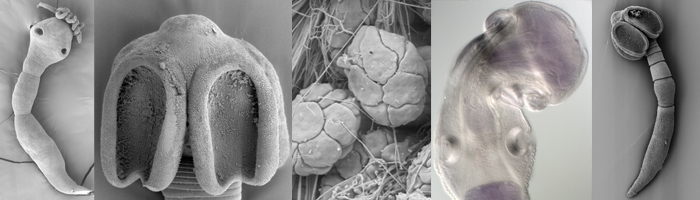
Scanning electron micrographs of Polypocephalus sp., n. gen. 1, and sperm; light micrograph of n. gen. 2; scanning electron micrographs of n. gen. 1
In general, lecanicephalideans are characterized by a scolex possessing 4 acetabula that are either sucker-like or bothridiate in form, an apical structure, and a vagina opening into the genital atrium posterior to the cirrus sac. Apical structure morphology is particularly diverse. For example, it may be in the form of tentacles (Polypocephalus), a small cone (e.g., Quadcuspibothrium), or larger sucker (e.g., Corrugatocephalum); species of Aberrapex and Paraberrapex lack an apical structure entirely. Most species range in total length from 2 mm to 5 cm, with the smallest measuring ~500 µm in total length.
Currently, 100 species in 19 genera are considered valid. Another 47 species are considered to be species inquirendae. At this time, familial boundaries are poorly understood and unstable.
Lecanicephalideans appear to be a monophyletic assemblage of cestodes that are basal in position relative to the other bothridiate orders. Phylogenetic relationships within the Lecanicephalidea are poorly understood.
The lecanicephalideans parasitize elasmobranchs (sharks and rays) as adults. They are primarily parasites of rays, although a few records from sharks do exist. Representatives of at least 14 families of rays have been reported to host lecanicephalideans, including stingrays, eagle rays, numbfishes, sawfishes, guitarfishes, and wedgefishes. In addition, lecanicephalideans have been reported from 6 species of sharks in 5 families, namely Carcharhinidae, Hemiscylliidae, Megachasmidae, Squatinidae, and Stegostomatidae.
Spiral intestine.
Lecanicephalideans are distributed in tropical and subtropical waters. The greatest diversity of lecanicephalideans appears to occur in the Indo-Pacific region, specifically the waters around India, Sri Lanka, Borneo, and Northern Australia.
While no complete life-cycle is currently known for any lecanicephalidean species, larva attributed to the Lecanicephalidea have been reported from a diversity of intermediate host groups, mainly molluscs and crustaceans, as well as a few teleosts; members of this order likely possess 2 and/or 3 hosts in their life-cycles.
Selected References:
Euzet, L. 1994. Order Lecanicephalidea. pp. 195-204. In Khalil, L. F., Jones, A., Bray, R. A. (Eds.) Keys to the cestode parasites of vertebrates. CAB International, Wallingford, U.K. PDF
Caira, J. N., K. Jensen, and C. J. Healy. 1999. On the phylogenetic relationships among the tetraphyllidean, lecanicephalidean and diphyllidean tapeworm genera. Systematic Parasitology 42: 77-151. PDF
Jensen, K. 2005. A monograph on the Lecanicephalidea (Platyhelminthes, Cestoda). Bulletin of the University of Nebraska State Museum 18: 241 pp. PDF
Waeschenbach, A., B. L. Webster, and D. T. J. Littlewood. 2012. Adding resolution to ordinal level relationships of tapeworms (Platyhelminthes: Cestoda) with large fragments of mtDNA. Molecular Phylogenetics and Evolution 63(3): 834-847. PDF
Taxon Coordinator:
Dr. Kirsten Jensen
University of Kansas
Dept. of Ecology and Evolutionary Biology
Natural History Museum and Biodiversity Research Center
1200 Sunnyside Ave., Haworth Hall
Lawrence KS 66045
U.S.A.
E-MAIL: jensen@ku.edu