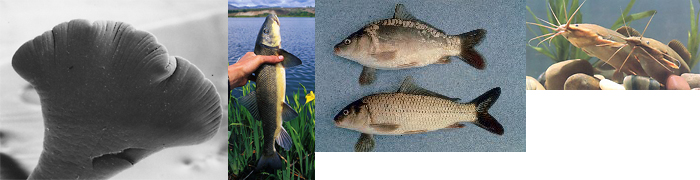
SEM of scolex of Caryophyllaeus laticeps; hosts of caryophyllideans: Catostomus sp., Clarias sp., Cyprinus sp. (Photos courtesy of T. Scholz)
Scolex unspecialized or with loculi, bothria-like structures, a terminal introvert or an apical disc (see Figs. 5.1–5.21 in Mackiewicz, 1994). Body non-segmented, monozoic possessing only a single set of male and female reproductive organs located mostly in posterior third of body. Testis number ranging from a few to several hundreds; external seminal vesicle may be present; cirrus unarmed. Ovary posterior, bilobed, H-, U-, V- or inverted A-shaped, compact or lobed. Vitelline follicles distributed usually circumcortical/circummedullary, rarely in 2 lateral columns, or. Genital pores separate or common, opening posterior to cirrus-sac, uterus tubular, convoluted, with or without uterine glands. Eggs operculate, unembryonated.
About 250 nominal species distributed in 42 genera (54% monotypic) and 4 families. Most genera are relatively low in diversity, with only 4 genera including 10 or more species.
Morphological data indicate caryophyllideans represent the most basal group of the Eucestoda, but molecular analyses have not unequivocally supported this placement. Intraordinal phylogenetic analysis, inferred from morphological and molecular data, indicates paraphyly of all non-monotypic families. The Caryophyllidea seem to be closely related to the Diphyllobothriidea.
Parasites of freshwater cypriniform and siluriform fishes.
Intestine.
All zoogeographical regions except Neotropical. Archigetes has been reported from tubificids in South America, but not from fish. A high degree of endemism is exhibited at generic level and only 8 of the 42 genera are recorded from more than 1 zoogeographical region.
Two-host life-cycle involves aquatic oligochaetes as intermediate hosts and benthic feeding fish as definitive hosts. Two genera (Archigetes and Paraglaridacris) are progenetic in tubificids.
Selected References:
Mackiewicz J. S. 1972. Caryophyllidea (Cestoidea): a review. Experimental Parasitology 31: 417-512. PDF
Mackiewicz J. S. 1981. Caryophyllidea (Cestoidea): Evolution and classification. Advances in Parasitology 19: 139-206. PDF
Mackiewicz J. S. 1982. Caryophyllidea (Cestoidea): perspectives. Parasitology 84: 397-417. PDF
Protasova, E. N., B. I. Kuperman, V. A. Roitman, and L. G. Poddubnaya. 1990. [Caryophyllidean fauna of the USSR.] Izdatel'stvo "Nauka", Moscow, 238 pp. [In Russian.] PDF
Mackiewicz J. S. 1994. Order Caryophyllidea van Beneden in Carus, 1863. In Keys to the Cestode Parasites of Vertebrates, L. F. Khalil, A. Jones, and R. A. Bray (eds). CAB International, Wallingford, U.K., pp. 21-43. PDF
Mackiewicz J. S. 2003. Caryophyllidea (Cestoidea): molecules, morphology and evolution. Acta Parasitologica 48: 144-154.
Oros, M., V. Hanzelová, T. Scholz, and J. S. Mackiewicz. 2008. Phylogenetic relationships of the monozoic tapeworms (Eucestoda: Caryophyllidea) inferred from morphological characters. Systematic Parasitology 70: 1–14. PDF
Brabec, J., T. Scholz T., I. Kráľová-Hromadová, E. Bazsalovicsová, and P. D. Olson. 2012. Substitution saturation and multiple copies of standard nuclear and mitochondrial phylogenetic markers in an unusual group of unsegmented tapeworms (Platyhelminthes). International Journal for Parasitology 42: 259–267. PDF
Taxon Coordinator:
Dr. Tomás Scholz
Institute of Parasitology
Academy of Sciences of the Czech Republic
Branisovská 31
370 05 Ceské Budejovice
Czech Republic
PHONE: ++420-38- 53-10-351
E-MAIL: tscholz@paru.cas.cz

