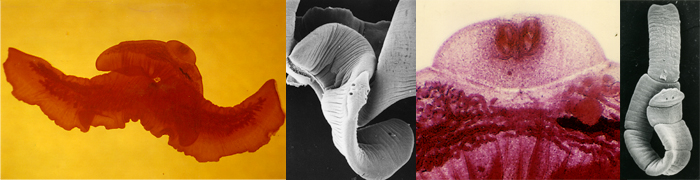
XX; SEM of; scolex of; SEM of Skrjabinotaenia compacta. (Photos courtesy of A. Jones)
Body small to medium sized. Scolex with 4 suckers, sometimes also with apical sucker. Genital apparatus single; testes numerous, in posterior part of proglottid; ovary typically asymmetrical. Genital pores alternating. Uterus tubular, with central stem and numerous prominent lateral branches.
Six genera and about 30 species.
Cladistic analyses based on morphological, developmental and, recently, molecular data, suggest that the Catenotaeniidae is a relatively basal family within the order Cyclophyllidea.
Rodents.
Small intestine.
Holarctic, Ethiopian, Asian and Neotropical regions.
Only the life cycle of Catenotaenia pusilla is known; for this species, mites are known as intermediate hosts.
Selected References:
Joyeux, C. and J. G. Baer. 1945. Morphologie, évolution et position systématique de Catenotaenia pusilla (Goeze, 1782), parasite de rongeurs. Revue Suisse de Zoologie 52: 13-51. PDF
Quentin, J. C. 1994. Family Catenotaeniidae Spasskii, 1950. pp. 367-374. In Khalil, L. F., Jones A., Bray, R. A. (Eds.) Keys to the cestode parasites of vertebrates. CAB International, Wallingford, U.K. PDF
Hoberg, E. P., A. Jones, and R. A. Bray. 1999. Phylogenetic analysis among the families of the Cyclophyllidea (Eucestoda) based on comparative morphology, with new hypotheses for co-evolution in vertebrates. Systematic Parasitology 42: 51-73. PDF
Taxon Coordinator:
Dr. Boyko B. Georgiev
Institute of Biodiversity and Ecosystem Research
Bulgarian Academy of Sciences
2 Gagarin Street
1113 Sofia
Bulgaria
E-MAIL: boyko_georgiev@yahoo.com