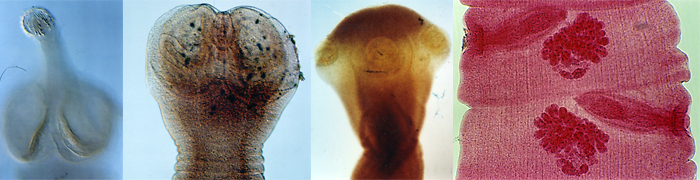
Scolex of Gyrocoelia perversa; scolex of Infula burhini; scolex of Shipleya inermis; mature proglottids of S. inermis (ex R. Rausch). (Photos courtesy of A. Jones)
Strobila large with numerous proglottids. Four suckers present, as exception can be absent. Rostellum present or absent; if present, armed or unarmed. Hook arrangement variable. Worms functionally dioecious; male and female worms entirely separate. Female strobila may retain male copulatory apparatus. Male organs within a proglottid single or paired; if single, genital pores alternate regularly. Testes numerous, in single median or 2 lateral groups. Internal seminal vesicle may present; external seminal vesicle absent. Cirrus-sac muscular; cirrus robust, armed. Genital pores alternate regularly or irregularly in female strobila, but absent in Dioicocestus. Female organs single. Typical vagina with external aperture absent but may be functionally replaced in female strobila by accessory ducts. Seminal receptacle poral to vitellarium, or between ovary and vitellarium. Ovary lobed, bi-alate to fan-shaped. Vitellarium postovarian. Early uterus transverse ring-shaped or horseshoe-shaped, often becoming sac-like. Uterine pore present or absent. Eggs oval.
Two subfamilies (Dioecocestinae and Gyrocoeliinae) recognized (considered as distinct families by some authors). Four valid genera. About 23 valid species.
Most closely related, according to cladistic analysis, to the Acoleidae, Amabiliidae, Progynotaeniidae and Hymenolepididae. Molecular analysis confirms the relationship with the Acoleidae and Progynotaeniidae, and a more distant relationship with the Amabiliidae and Hymenolepididae.
In charadriiform, ciconiform, and podicipediform birds.
Intestine.
Cosmopolitan.
No complete life-cycles known.
Selected References:
Ryzhikov, K. M. and L. M. Tolkatcheva. 1975. [Acoleata - cestodes of birds.] Osnovy Tsestodolojii 10: 215. [In Russian.] PDF
Jones, A. 1994. Family Dioecocestidae Southwell, 1930. pp. 391-398. In Khalil, L. F., Jones, A., Bray, R. A. (Eds.) Keys to the cestode parasites of vertebrates. CAB International, Wallingford, U.K. PDF
Hoberg, E. P., A. Jones, and R. A. Bray. 1999. Phylogenetic analysis among the families of the Cyclophyllidea (Eucestoda) based on comparative morphology, with new hypotheses for co-evolution in vertebrates. Systematic Parasitology 42: 51-73. PDF
Taxon Coordinator:
Dr. Arlene Jones
Department of Zoology
The Natural History Museum
Cromwell Road, London, SW7 5BD
U.K.
E-MAIL: a.jones@nhm.ac.uk